Do your own inspection first, then hire an independent marine surveyor, then run a sea trial before you sign. The inspection costs you a morning and tells you whether the boat deserves a survey. The survey is the report that lets you walk away or renegotiate. On the Gold Coast, published pre-purchase survey rates for a 50 to 59 ft motor yacht run from about $1,500 to $1,600 before extras, which is a small amount against what a bad purchase costs.
Key facts
- Three different things — your own walk-through, the surveyor’s report, and the sea trial
- Survey, 50 to 55 ft — $1,499 at Maritime Surveyor; 50 to 59 ft $1,600 at BoatBuy, plus $210 per engine
- Quoted on application — from 56 ft at Maritime Surveyor, from 60 ft at BoatBuy
- Extras — lift-out (the yard bills it), generators $210 each, oil analysis $185 to $199 a sample
- Registration — transfer into your name within 14 days; at 15 m or longer Maritime Safety Queensland must endorse it
- Independent — appoint your own surveyor, not the seller’s or broker’s
Inspection, survey and sea trial: three different jobs
People use these words as if they meant the same thing. They do not.
- Your own inspection. A walk-through with a torch, a checklist and the paperwork. It costs nothing and its job is to eliminate boats. If she fails here, you have saved a survey fee.
- The survey. A surveyor's written report on the whole vessel, usually with photographs. Nearly everything is inspected, covers are unscrewed and the items that could not be reached are listed as not inspected. A small patch of antifoul is removed so the surveyor can take moisture readings on a fibreglass hull.
- The sea trial. A test run, usually part of the survey, that shows how she steers, trims and performs under load. It can reveal handling problems, steering or trim issues and thrusters that are too small or cavitate. It has to be agreed in advance with the seller and the surveyor.
A pre-purchase survey is not an insurance survey. An insurance survey is shorter, covers the main items that decide seaworthiness and does not need a sea trial. A full pre-purchase report can often do both jobs, which is why it is the one to buy first. Check with your insurer that they will accept it.
 From The Yacht Owner's KitPre-Purchase Inspection Checklist$12See it →
What to check yourself first
Do this before you pay anyone. A boat in this class, a 40 to 120 ft Sunseeker, Azimut, Pershing or Princess, comes with long service histories, and the paperwork often tells you more than the hull does.
The paperwork. - Registration and ownership. Check that the seller is the registered owner and that the registration is current. Queensland lets you check a boat’s registration online, through the Rego Check app or on 13 23 80. - Finance owing. A financier records its interest in a boat on the Personal Property Securities Register, and a search on the hull identification number shows it. Boatsonline puts that search at about $2. A boat with a security interest registered can be repossessed, so ask for the payout and discharge in writing. - Certificate of currency and claims history. A current certificate and a straight answer about past claims, groundings and repairs. - Survey history. Ask for the last survey and every report since. A boat that has been surveyed before has been checked before, and you can compare. - Service records. Engine, generator, gearbox and stabiliser services, with dates and hours, from the people who did them. Gaps matter more than hours.
The hull and deck. Look along the topsides in low light for waves, patches and mismatched gelcoat. Check the swim platform and its hydraulics, the deck fittings, the windows and hatch seals, and whether the teak has lifted. Stains on the saloon headlining or around fittings mean water is getting in.
Underwater, if she is out. Props for damage, shafts for wear and play, rudders for movement, anodes for how fast they have been used, and the through-hulls and seacocks for corrosion. If she is in the water, ask for her last haul-out record and when the running gear was last pulled.
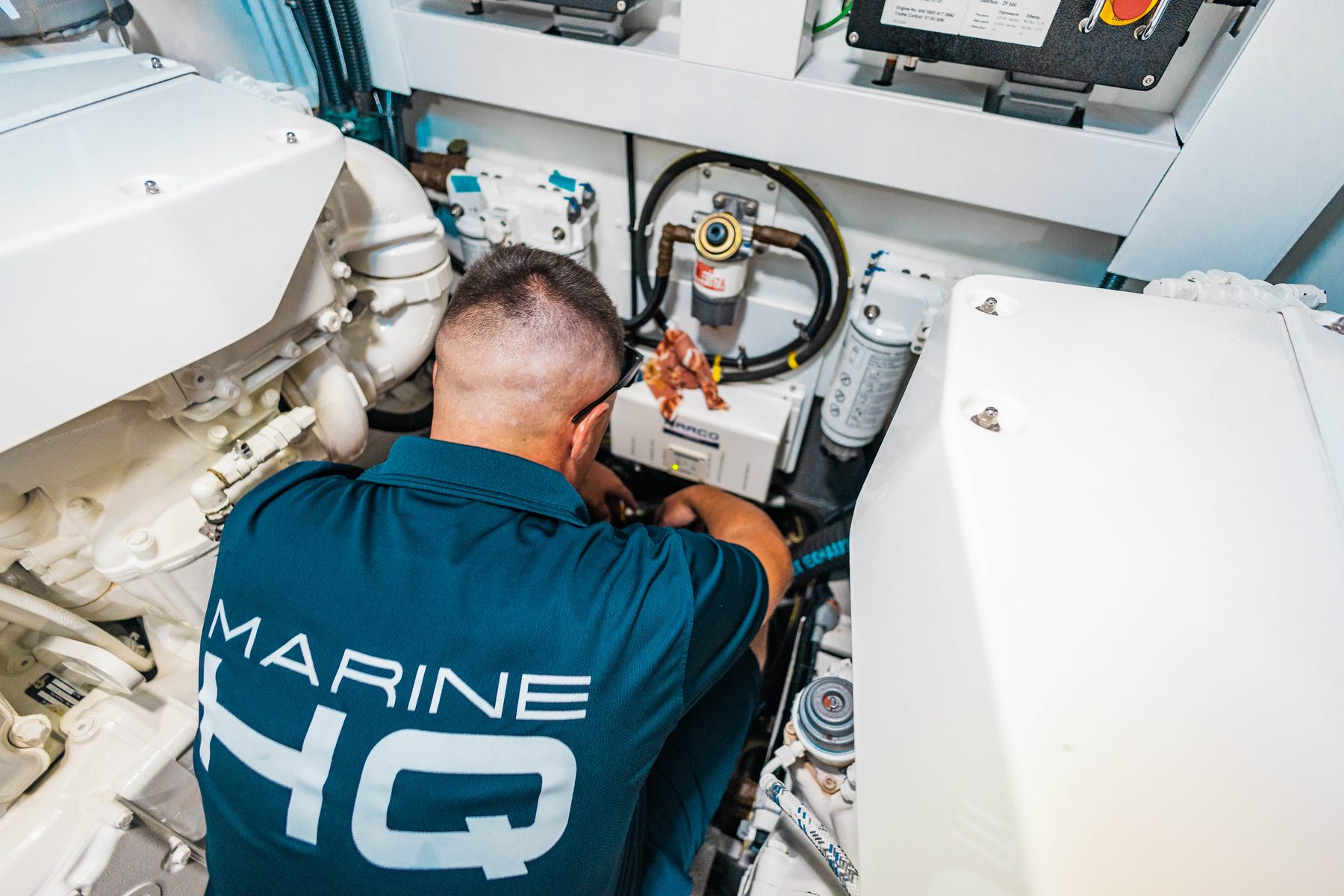
Engines and gensets. Cold start, no smoke after the first minute, a clean engine bay with no fresh oil or coolant, and no leaking from the raw-water pumps. Look at the hour meters and ask whether they match the service records.
Electrics and systems. Shore power, batteries and chargers, air conditioning, the generator under load, thrusters, windlass, pumps, bilge alarms and navigation electronics. Turn everything on at once and listen.
Stabilisers. Fins or gyro, whichever she has. Ask when they were last serviced, and test them at the sea trial.
Worth knowing
A survey is the report. It is not a guarantee. Parts that cannot be reached, such as fuel tanks boxed in behind joinery, are listed as not inspected, and specialist items like complex electronics or carbon fibre may need a specialist. Read the exclusions page as carefully as the findings.
Red flags
- The seller will not allow a survey, a lift-out or a sea trial. Walk away.
- A “preferred” surveyor. A broker or seller steering you to one person is a reason to choose someone else.
- Records that stop. Missing service history for the engines, generators or stabilisers.
- Fresh paint in odd places. In the engine room, around the bilges, below the waterline or on one side only.
- Hour meters that do not match the logbook.
- A hull identification number or plate that is missing, altered or does not match the paperwork.
- Water where water should not be. Damp lockers, soft deck, a smell in the bilge.
- Pressure. A deposit with no subject-to-survey clause, or a price good only until the show finishes.
What a surveyor does
A surveyor inspects the hull, structure, systems and safety gear, takes moisture readings, reviews the documents, runs the sea trial and writes a report with photographs. The published Gold Coast rates include the sea trial. In practice you also get a list of defects that you can use to negotiate or to walk away.
There is no regulation that sets minimum qualifications for calling yourself a marine surveyor, so the credentials need checking. The Australasian Institute of Marine Surveyors vets its members and assigns membership levels that reflect their experience, and you can search its database. Beyond that, ask whether they carry professional indemnity insurance, whether they have surveyed your make of boat, and for a sample report.
Engines are the common gap. Some surveyors do not inspect engines, and others only confirm they run. For big diesels, book an independent marine engineer who knows the make, ideally not the one who last serviced them. Oil analysis and a borescope inspection are the usual tools.
What a survey costs in Australia
Two Gold Coast and Brisbane firms publish their rates. These are what they say today, with GST included.
| Boat length | Maritime Surveyor | BoatBuy |
|---|---|---|
| 30 to 36 ft | $899 | $1,075 (30 to 39 ft) |
| 37 to 43 ft | $1,099 | $1,075 (to 39 ft), $1,300 (40 to 49 ft) |
| 44 to 49 ft | $1,299 | $1,300 |
| 50 to 55 ft | $1,499 | $1,600 (50 to 59 ft) |
| 56 ft and over | Quote on application | $1,600 to 59 ft, then quote from 60 ft |
BoatBuy adds $210 for each engine inspected, $210 per generator, $185 per oil sample and $265 per tender. Maritime Surveyor prices a marine engine oil analysis from $199 and quotes thermography, ultrasonic thickness testing, moisture meter testing and endoscope inspections on application. Maritime Surveyor’s page also lists a lower “special price” that runs to 20 December 2026. Neither page gives a price for the lift-out. That is the yard’s, so ask for a quote.
A worked example. A 55 ft twin-engine motor yacht with one generator, on BoatBuy’s published rates:
| Item | Cost |
|---|---|
| Survey, 50 to 59 ft, includes sea trial | $1,600 |
| Two engines at $210 | $420 |
| One generator | $210 |
| Three oil samples at $185 | $555 |
| Total before lift-out | $2,785 |
On Maritime Surveyor’s published rates the same boat is $1,499, plus three oil analyses from $199 each, or from $2,096. The lift-out is on top. From 56 or 60 ft, up to the 120 ft end of this audience, the price is on application: ask for it in writing and ask what it includes.
When to call a surveyor, and when to call someone else
Call a surveyor when you are serious about a boat and the seller has agreed to a survey and sea trial, so the money is spent on a boat that has passed your own inspection. Do not pay for a full survey on a boat that failed your walk-through.
Call a specialist on top when the survey leaves a question. A marine engineer for the engines and gensets, a stabiliser technician for the fins or gyro, and an electrician if the electrics are complicated. Each is a few hundred dollars and each can find a five-figure problem.
How we help
We are a yacht management company, not a surveying firm, so we do not replace the surveyor. What we do is the work around the survey. Marine HQ runs a pre-purchase consultation for buyers. We look at the listing with you before you spend anything, go through the boat with you, read the survey report and the service records against what the boat will need, and put a Gold Coast figure on each finding and on running her here. You then go back to the seller with a list that is priced, not just a list.
After you buy
Transfer the registration within 14 days. At 15 m or longer the application must be endorsed by Maritime Safety Queensland before Transport and Main Roads can process it. Insure her from the day you take delivery, and book your first haul-out. Our annual haul-out checklist is the scope to start from, and the size guide covers the running costs you are signing up for.