The honest answer is that length is the last thing to decide, not the first. Four questions settle it: how you will use her, who sleeps aboard, where she will live, and who will drive her. Answer those and the size falls out, along with the budget to run her, which on the Gold Coast is roughly 10 to 15% of her value a year. For most owner-operators here the answer lands between 50 and 65 ft. Here is why, what each ten feet buys and costs, and where the Gold Coast itself sets limits.
Key facts
- The four questions — use, people aboard overnight, where she lives, who drives
- The couple’s ceiling — 60 to 65 ft comfortable, 70 to 75 ft the stretch, above 75 ft almost always crewed
- Three cabins — from about 55 ft in the luxury production boats; four cabins from about 65 ft
- Berth by length — Southport Yacht Club member rate: 49 ft $10,230 a year, 59 ft $16,087, 66 ft $23,954, 73 ft $29,308, 82 ft $38,226
- The insurers’ ten-foot rule — experience on a boat within about ten feet of the one you are buying, or a captain signs you off
- Running costs — 10 to 15% of value a year is the Australian brokers’ rule of thumb
The four questions
Every credible buying guide, from the yacht brokers to Club Marine to Boat Gold Coast, comes back to the same four.
- How will you use her? Day runs to the Broadwater and Wave Break, weekends at anchor at Tipplers or Moreton Bay, a fortnight up the coast each winter, or the Whitsundays every season. Day boating is happy at 40 ft. Weekends want proper cabins, a galley and enclosed heads. Coastal cruising wants tankage, storage and a hull that behaves in a following sea.
- Who is aboard overnight? Count beds, not deck chairs. A couple who host day guests need one great cabin and a big cockpit. A family of four who also bring friends need three cabins and two heads, which is a 50 ft boat, not a 45.
- Where will she live? The berth sets the length as surely as the budget does. Dry stacks on the Gold Coast stop at about 10 m. Marina berths come in bands, and the jump from a 59 ft berth to a 66 ft berth at Southport is $7,900 a year.
- Who drives her? If the answer is you, the honest ceiling for a couple is 60 to 65 ft, 70 to 75 with pods, thrusters and practice. Above that you are hiring a captain, and the boat's cost changes character. Our crew guide has the numbers.
Worth knowing
Boat Gold Coast’s advice is the least glamorous and the most useful: sit down with your family first and agree who will use the boat, where it will go and what you will actually do on it, before you look at a single listing. The size argument usually ends there.
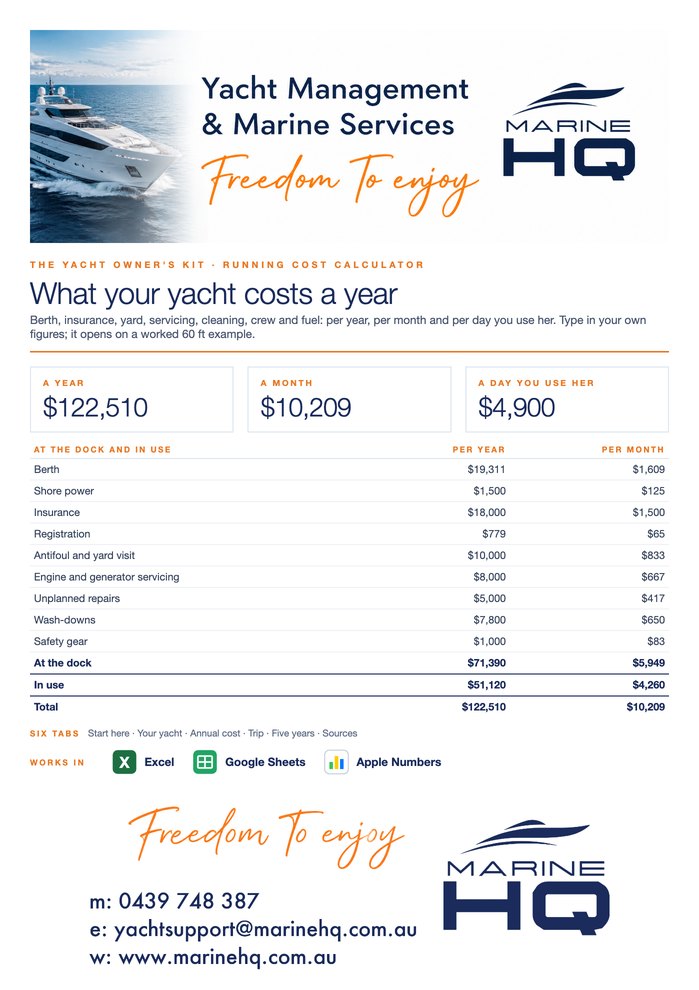 From The Yacht Owner's KitRunning Cost Calculator
What each ten feet buys you
The luxury production boats make the bands easy to see. Volume grows with the cube of length, so a 60-footer is not a fifth bigger than a 50; owners who have done it describe the 50 as three times the boat.
| Length | Yacht | Cabins | Beam | Fuel and water | Who runs her |
|---|---|---|---|---|---|
| 54 ft | Sunseeker Predator 50 | 2 cabins, room for a tender behind the transom | 4.48 m | 1,800 L / 430 L | Owner, easily |
| 58 ft | Princess F55 | 3 cabins plus a crew cabin, 2 bathrooms | 4.87 m | 2,750 L / 608 L | Owner |
| 64 ft | Sunseeker Manhattan 60 | 3 en suite cabins plus crew quarters | 5.0 m | 3,000 L / 700 L | Owner, or day crew |
| 66 ft | Princess F65 | 4 cabins | 5.10 m | 4,100 L / not stated | Owner with help, or captain |
| 71 ft | Azimut S7 | 4 staterooms plus a crew cabin | not stated | about 3,800 L / not stated | Captain, or a very experienced owner |
| 77 ft | Sunseeker 76 Yacht | 4 cabins plus a crew cabin | 5.95 m | 6,000 L / 1,400 L | Captain |
Lengths are each builder’s or reviewer’s length overall (the 76 Yacht’s 23.6 m includes the pulpit). The Azimut S7’s tank is 1,004 US gallons in Yachting magazine’s review, converted here. Where a review did not state a figure, the table says so.
Two things move with length that buyers underestimate. The tender grows with the boat: a swim-platform tender is about 3 m on a 12 to 15 m yacht and 3.5 m on a 20 to 25 m yacht, and the Predator 50 has room for a Williams 325 behind the transom, the Azimut S7 carries its tender in a garage under the sun pad, and the Pershing GTX80’s hydraulic platform takes a Williams 345. The systems grow with it: air conditioning on a boat this size means a generator, and the gyro that stops her rolling at anchor is a Seakeeper 10 on a 50 to 60 ft boat, list price about US$127,000 before installation, and a Seakeeper 18 at 60 to 75 ft.
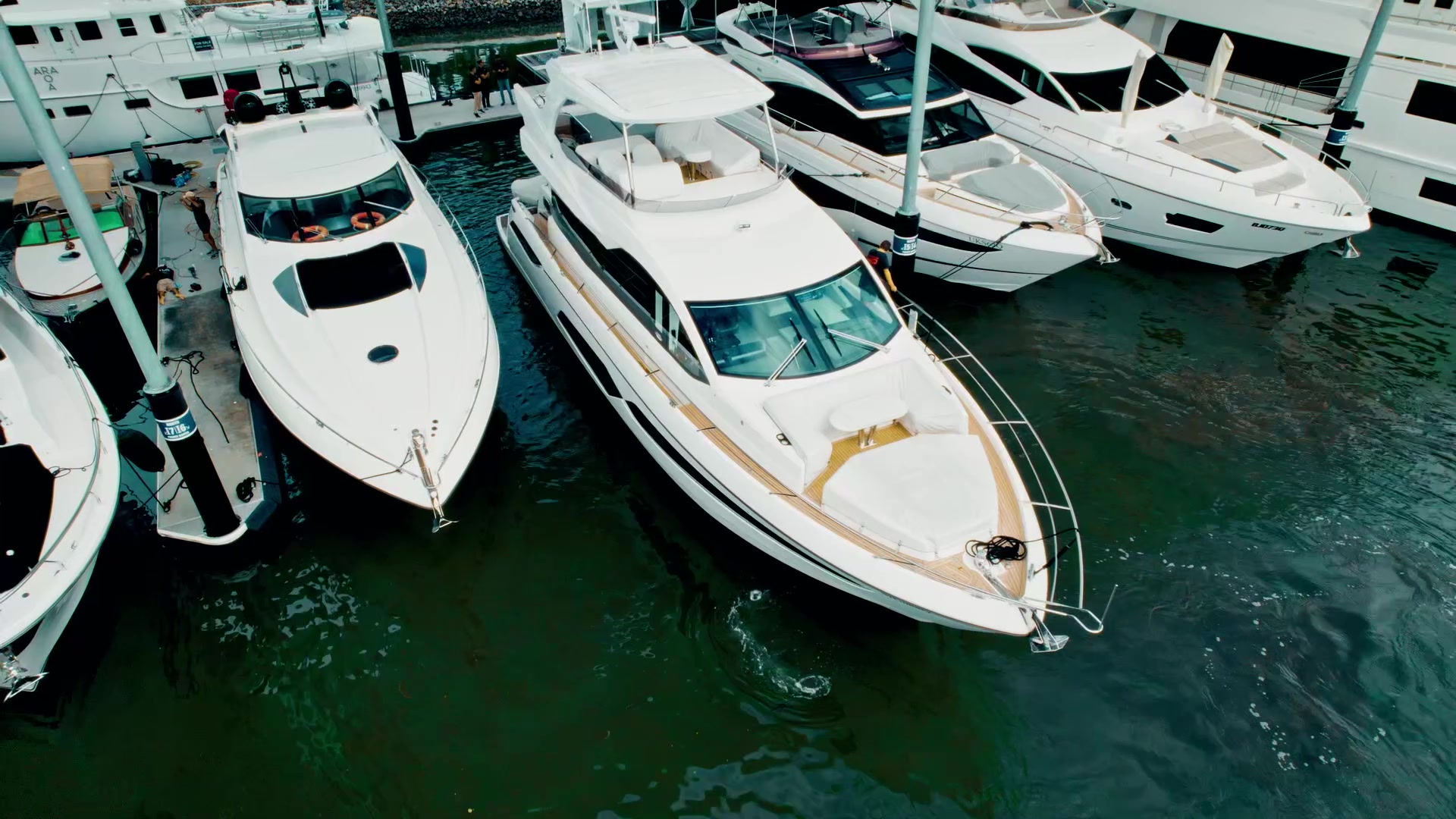
How the running costs scale
Every line scales with length, and some scale faster than length.
| At | Berth, SYC member, a year | Fuel burn at cruise, from sea trials and builder’s figures | Antifoul | Crew |
|---|---|---|---|---|
| 49 ft | $10,230 | Not published for a luxury boat this size; see the 55 ft row | GCCM package from $89.50 a foot to 50 ft, about $4,400 | Owner |
| 55 ft | $16,087 (59 ft double) | Princess F55 (58 ft): about 215 L/h at 23 to 24 knots; Sunseeker Predator 50 (54 ft): 167 L/h at 20 knots | Quote only above 50 ft | Owner |
| 60 ft | $19,311 (59 ft single) | Sunseeker Manhattan 60 (64 ft): 196 L/h at 20 knots, 256 at 23.6; Grand Banks 60: 86 L/h at 15 knots, 228 at 25 | Quote; allow around $10,000 all in | Owner or day crew |
| 65 ft | $23,954 (66 ft) | Princess F65 (66 ft): 274 L/h at 21 knots; Palm Beach 65: 165 L/h at 25 knots | Quote | Owner with help |
| 68 to 73 ft | $29,308 (73 ft) | Azimut S7 (71 ft): 245 L/h at 24.8 knots, 326 at 28.9 | Quote | Captain likely |
| 82 ft | $38,226 | Sunseeker 76 Yacht (76 ft, builder’s figures): 290 L/h at 23 knots; Pershing GTX80: 439 L/h at 28 knots; nothing we trust is published above 80 ft | Quote | Captain and crew |
From 80 to 120 ft the numbers stop being published and the rules change. Southport quotes berths over 82 ft on application; GCCM’s 2022 schedule had 91–100 ft at $5,000 a month and 101–110 ft at $6,000. Published guidance is that a crew member is recommended from about 79 ft and a professional crew above about 98 ft, and the Crew Pacific guide puts a captain on a 100 to 120 ft yacht at $10,000 to $14,000 a month including super. At this size the question is less which boat than who runs her, which is our crew guide.
Southport Yacht Club is the only Gold Coast marina with a published rate card; the others quote, and the resort marinas cost more. Visitor rates at Southport are 40 to 50% above member rates. Insurance follows the sum insured, so it scales with price rather than length, at somewhere between 1 and 3% of value a year. The 10% rule of thumb holds well for a new owner-operated boat under warranty and understates an older or larger one, which is why Australian brokers say 10 to 15%. Our cost-of-ownership guide builds the whole bill for a 60-footer.
What the Gold Coast decides for you
- Water. The Coomera River channel to the marine precinct carries about 3.0 m; the published guideline for the run from the Seaway is a 2.1 m draught without a pilot, 3 m to Southport Yacht Club. Every boat in the table above fits, but a deep-keeled displacement boat wants the tide up the river.
- Speed. Six knots for vessels 6.5 m and over from Paradise Point up the Coomera River, so a Coomera berth means an hour and a half each way at displacement speed whatever you own.
- Bridges. Sovereign Islands 5.0 m, Ephraim Island 5.9 m, the Sundale Bridge 4.5 m at highest tide. A flybridge boat does not go under any of them; plan the berth accordingly.
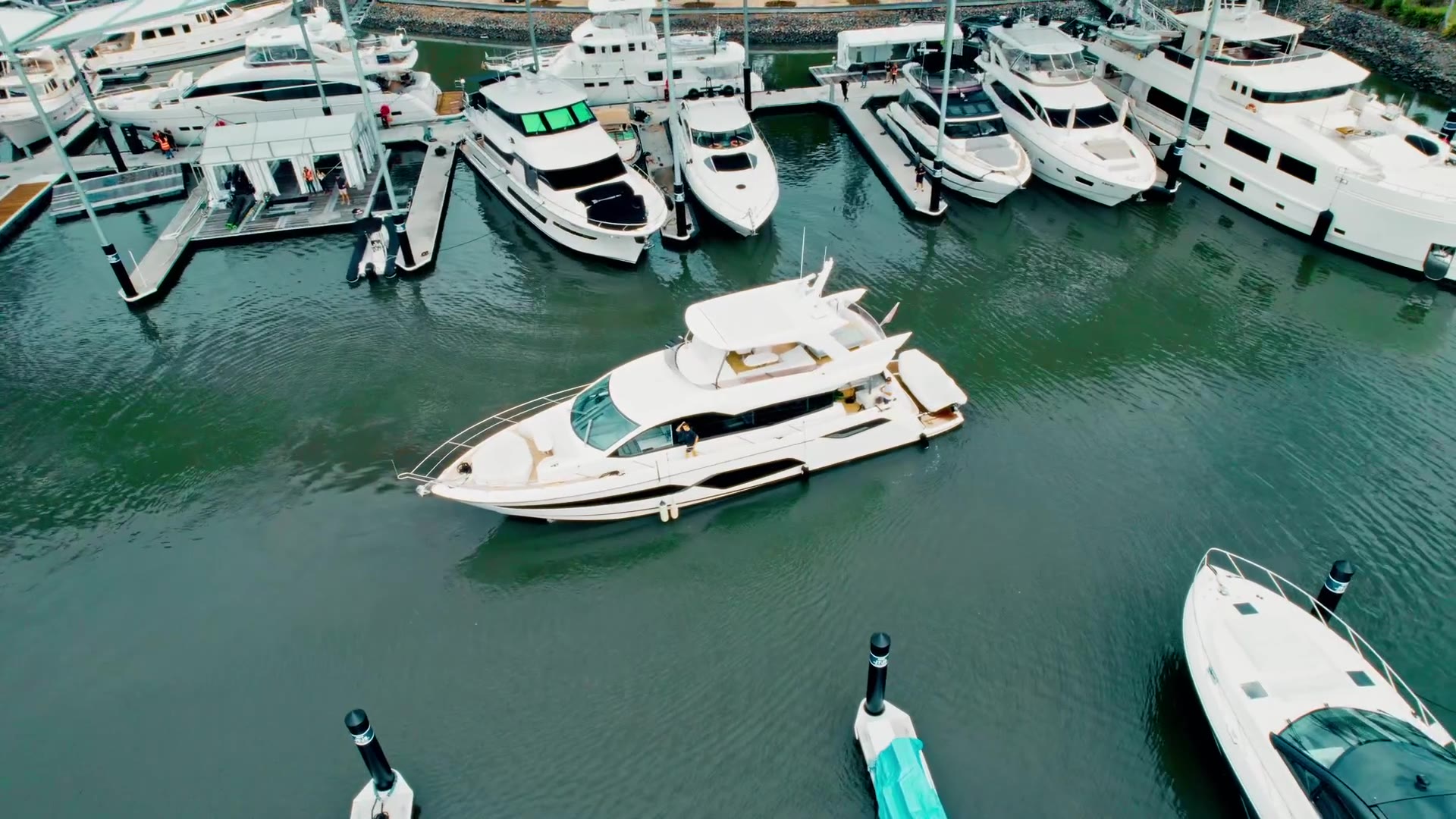
- Berths. Runaway Bay to 30 m, Hope Harbour to 40 m, Sanctuary Cove to 65 m, Southport to 130 m. Dry stack to about 10 m or 14 tonnes at GCCM, so nothing in this guide goes in a shed for the season.
- The Seaway. The safest bar in south-east Queensland, but nasty on the ebb against a swell. A 50-footer and a 75-footer cross it the same way: on the flood, logged on with Seaway Tower.
The ten-foot rule
Underwriters look for experience on a boat no more than about ten feet shorter than the one they are insuring. A 40 to 50 step is normal; 25 to 50 is not. Above the jump they attach a condition: a professional captain aboard until they sign you off, anywhere from a week to a season. Insurers count boats you have owned, not boats you have driven.
Owners who have made the jump say the same thing on every forum: step up in stages, or charter the size first. Docking a 60-footer with pods and a joystick is easier than docking a 40-footer with shafts, but the boat itself, the systems, the yard bills and the hours of upkeep are what change, and they change by the cube.
Hull type and range
A planing hull gets you to Moreton Bay for lunch; a displacement hull gets you to the Whitsundays on a third of the fuel. Full-displacement boats cruise at 6 to 9 knots, semi-displacement at 10 to 16 and beyond with power, and planing boats’ running costs are commonly 50 to 150% higher than a displacement boat of the same length. The Grand Banks 60 shows the trade: 2,000 nm at 10 knots, 636 nm at 25. A Princess F65 carries 4,100 litres for about 252 nm at 21 knots, and Yachting magazine’s Pershing GTX80 test gives 300 nm at 28 knots, with nearly double that at slow cruise. If the plan is a season north, tankage and range at the speed you will actually run matter more than the length.
What it costs to buy
Published prices from tests, reviews and listing sites, in the currency and year each was quoted, so you can see the bands. The Sunseeker Predator 75 and 76 Yacht rows are dealer asking prices, which move, so each carries its date.
| Boat | Length | Published price | When |
|---|---|---|---|
| Sunseeker Predator 75 | 75 ft | $7.99 million (2025 boat, NSW dealer) to $8.4 million (2026 boat), new, asking | Australian listing sites, October 2026 |
| Sunseeker 76 Yacht | 77 ft | used, asking: US$2.4 million to US$4.9 million, average US$3.9 million | YachtBuyer listings, October 2026 |
| Azimut S7 | 71 ft | from €2.75 million, the price given for the 2023 premiere (not a current offer) | ilodka, 2023 premiere |
| Sunseeker Predator 50 | 54 ft | from £810,000 including VAT (UK) | review published March 2019 |
| Princess F55 | 58 ft | $3.49 million base, $3.79 million as tested | May 2023 |
| Sunseeker Manhattan 60 | 64 ft | about $3 million, depending on options | Trade-A-Boat review, undated |
| Grand Banks 60 | 60 ft | $4.13 million base, $4.5 million as tested | 2018 |
| Palm Beach 65 | 65 ft | about $4.2 million as tested | 2018 |
| Princess F65 | 66 ft | £3.3 million as tested including VAT (UK) | review published March 2023 |
The UK prices are in pounds and include VAT, so they are a guide to the band, not an Australian price. The Manhattan 60 review gives no currency or date for its figure, and the 76 Yacht figures are US-dollar asking prices from listings worldwide, mostly boats between six and nine years old.
Depreciation runs roughly 10 to 20% in the first year, 30 to 40% by year three and 40 to 50% by year five, then flattens. That is the case for a three to five year old boat: the big hit is taken, the warranty may still have life, and the survey tells you what you are buying. The Australian luxury segment gained share in late 2025 while trailer boats fell. Brokers put the deepest demand in the 30 to 70 ft power range, so a well-kept boat in this band is also the easiest to sell when you move up.
Two schools of thought on the first boat, and both are right for someone. “Buy your second boat first” skips the starter boat you will outgrow in a year. “Start small” makes sure you like it before you commit. The compromise most experienced owners land on is a boat one size below the dream, run for two seasons, with the records kept so she sells well.
Before you decide
- Sea-trial her on a choppy day with the people who will normally be aboard, not on a flat morning with the broker.
- Ask the twenty questions the brokers publish: engine hours, last major service, last antifoul, fuel burn at cruise, how she handles in a tight marina, what berth she needs, and what she costs a year.
- Add 5 to 12% to the purchase price for survey, registration, first-year insurance and the berth deposit.
- Walk the berth you can actually get before you sign. On the Gold Coast the berth, not the boat, is often the constraint.
- Budget the running costs at 10 to 15% and see whether the bigger boat still fits the number.
What we do
Marine HQ’s pre-purchase consultation is exactly this conversation with your shortlist in front of us: what each boat will cost to berth, antifoul, insure, fuel and crew on the Gold Coast, whether you can run her yourself, and what the survey and sea trial should look for on that particular model. We look after boats across every size in the tables above, here on the Gold Coast. Call 0439 748 387 or email yachtsupport@marinehq.com.au before the deposit, not after.