An SOP, a Standard Operating Procedure, is the written way a job is done on your yacht. Not how a generator works in general, but how this generator is started on this boat, in what order, with which breakers, and what to check before you walk away. A commercial vessel has to have them. A private yacht does not, and most do not, which is why so much of what a yacht knows lives in one person’s head. Here is what they are, why they work, which ones matter, and how we write them.
Key facts
- What it is — one or two pages: the steps in order, the limits, and a checklist, written for one yacht
- Required? — for commercial vessels, yes, under Marine Order 504; for a private yacht, no
- Why bother — the boat runs the same way whoever is aboard, and nothing depends on memory
- Start with — pre-departure and stand-down, then anchoring, tender, fuelling, power changeover and emergencies
- Where they live — in print aboard, and on your phone in the MyYacht app
- Ready-made — the three everyday checklists are $7; anything specific to your yacht is written for her
Why a checklist works
The best evidence comes from surgery. In 2009 a World Health Organization study across eight hospitals introduced a 19-item checklist read aloud before, during and after an operation. Major complications fell from 11% to 7% of patients, and deaths from 1.5% to 0.8%. Nothing about the surgeons’ skill changed. What changed was that the routine steps stopped depending on memory, and that everyone in the room knew the plan.
Aviation has worked this way for decades, and the lesson transfers directly to a yacht. The people who run boats well are not the ones who remember everything. They are the ones who do not have to.
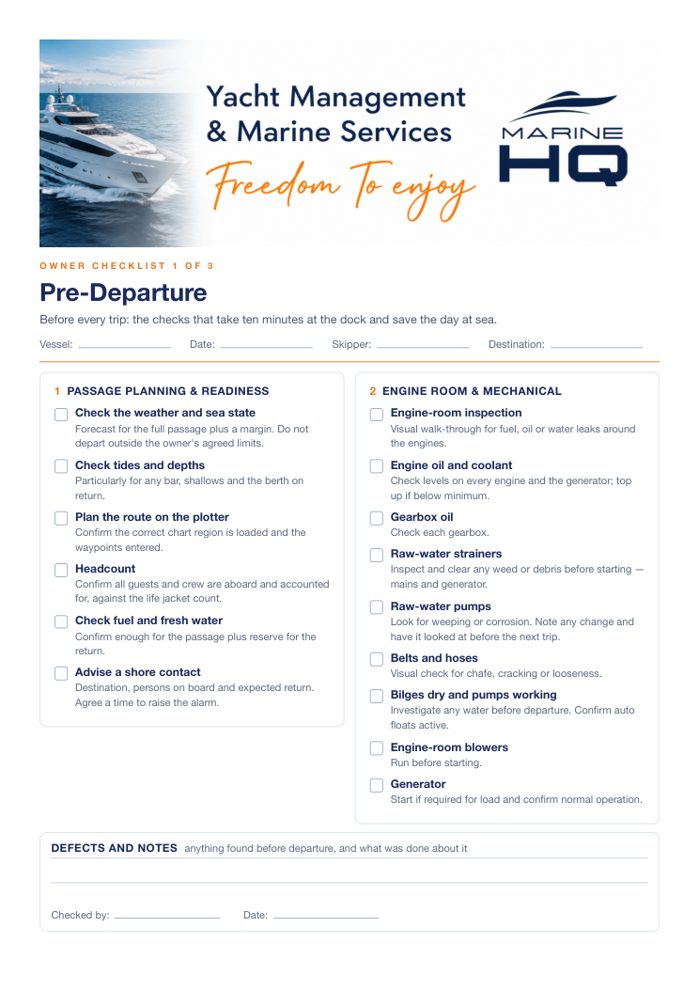 From The Yacht Owner's KitOwner Checklists: Pre-Departure, Stand Down, Wash-Down
What goes wrong without them
- The seacock left open, the shore power left off, the hatch left ajar. Most damage at the dock is something left on, left open or left unrecorded after a trip.
- Two people, two methods. The owner anchors one way, the weekend skipper another, and the windlass pays for the difference.
- The guest brief that never happens. Life jackets, the raft, the fire blanket, and which door not to open under way.
- The captain who leaves. Yacht crew turnover runs at 20 to 40% a year, and a 2023 survey found 40% of captains planning to look for a new boat. A proper handover is meant to include the equipment lists, the procedures for critical equipment, the maintenance history and the open defects. If none of that is written down, there is nothing to hand over.
What the law says
A domestic commercial vessel in Australia must operate under a safety management system. Marine Order 504, revised from 1 June 2025, requires documented procedures for onboard operations and emergencies, crew training and drills, and clear roles and responsibilities. That is the standard a charter yacht works to.
A recreational yacht is outside that system. AMSA is specific that paying someone to operate or crew her does not make her commercial. So a private owner has no obligation to write anything down, which is exactly why the well-run private yachts borrow the commercial habit.
Worth knowing
If there is any chance your yacht will go into charter, the procedures are the first thing the safety management system needs. Writing them while she is private is far easier than writing them the month before survey.
The SOPs every motor yacht should have
| Procedure | When it is used | What it prevents |
|---|---|---|
| Pre-departure | Every trip | Leaving with a fault you could have found at the dock |
| Stand-down | Every trip | Flat batteries, flooded bilges, an unlocked boat |
| Anchoring and anchor retrieval | Every night at anchor | Windlass damage, a fouled anchor, dragging |
| Tender launch and recovery | Every day at anchor | Davit and crane overloads, crushed fingers |
| Fuelling | Every fill | Spills, the wrong tank, static and fumes |
| Shore power and generator changeover | Every arrival and departure | Tripped supplies, damaged inverters and chargers |
| Guest safety brief | Every new guest | The questions nobody asks until it matters |
| Fire, flooding, person overboard | Hopefully never | Losing the first two minutes |
| Storm and cyclone preparation | Each season | A scramble when a warning is issued |
| Her own specials | As fitted | Stabilisers, passerelle, watermaker, tender garage |
The first two are the same on almost every motor yacht. Everything below them depends on her equipment, which is why a template only gets you so far.
What a good SOP looks like
- A header that says which boat and which equipment. Vessel, the system it covers, the date and who wrote it.
- The purpose in one line. What the procedure is for and when it is used.
- The limits. Wind, depth, load, engine state: the conditions under which you do not do this.
- The steps, in the order you do them. Short lines, one action each, using the names on her own switches and valves.
- The warnings where they apply. Next to the step, not in a paragraph at the end.
- A checklist. The same steps as tick boxes, for the day you are doing it rather than learning it.
- What to do when it does not work. The windlass will not retrieve; the generator will not take the load.
One or two pages. If it is longer, it is a manual, and it will stay in the drawer.
How SOPs help beyond the dock
Crew changes. A new captain or a relief skipper reads the procedures and runs her the way she has always been run. The owner does not spend a season re-teaching the boat.
Insurance. No Australian policy asks for SOPs by name. But they exclude claims when the boat is under the control of someone without adequate experience to control her, and the proposal form asks about your experience, any boating course, and how the boat is maintained. A yacht with written procedures and a schedule is an easier story to tell an underwriter, and an easier one to tell after an incident.
Resale. A buyer is paying for the boat and for the evidence that she was looked after. A bound set of procedures, the maintenance schedule and the records is what a surveyor asks to see.
Family and guests. The person most likely to be at the helm when you are not is someone who knows the boat less well than you do.
How Marine HQ writes them
We write SOPs aboard, with whoever runs the yacht, because the detail that matters is in her own equipment: which breaker, which valve, which side the passerelle stows. Each one follows the structure above and is checked by running it.
Most owners take them as part of the Vessel Dossier, the bound record we produce for a yacht: her particulars, an emergency response card, a safety checklist, a tailored maintenance schedule, an insurance summary, a compliance register and contacts, with pre-departure and one further procedure of your choice, in print and digital. Further SOPs are added singly or in sets, and the whole set is reviewed each year. It is quoted per yacht.
In the app, on your phone
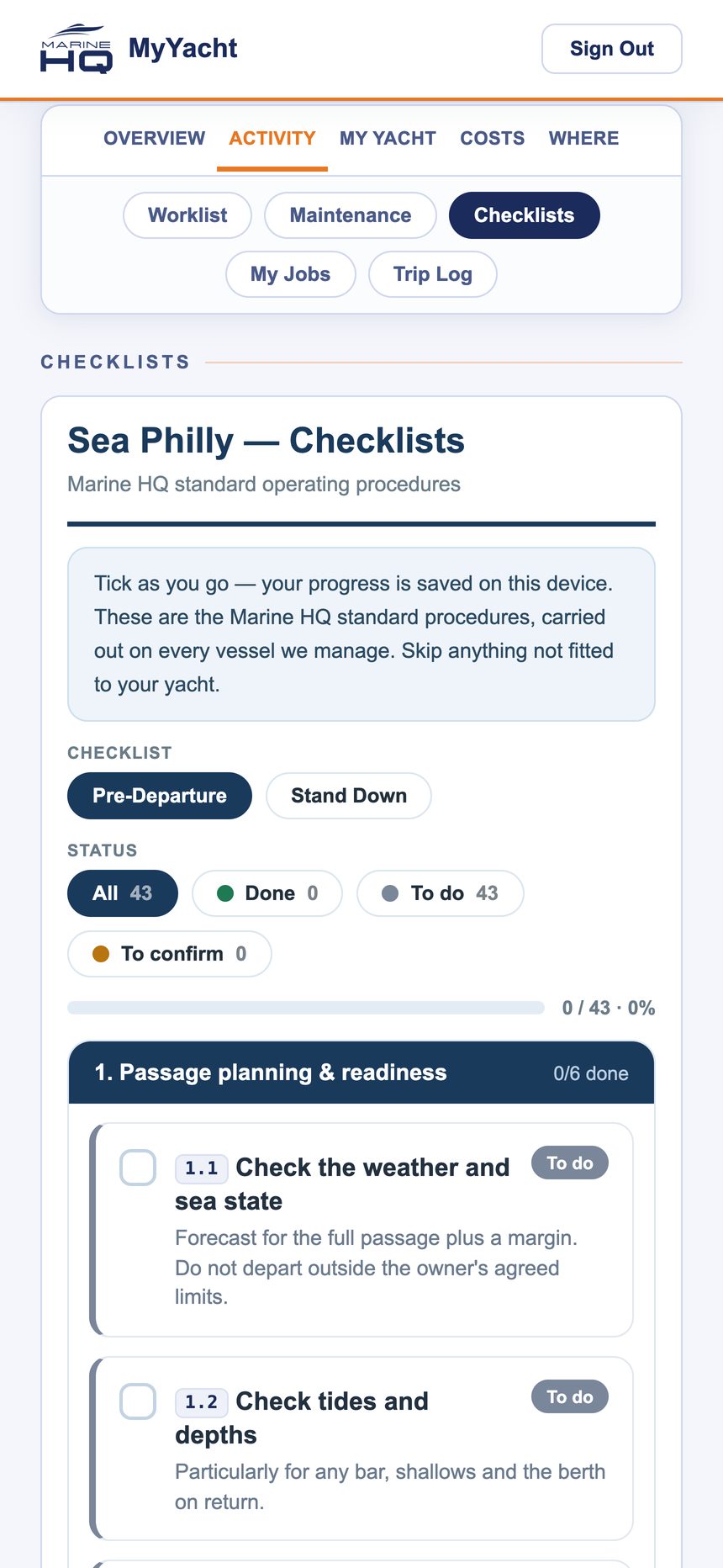
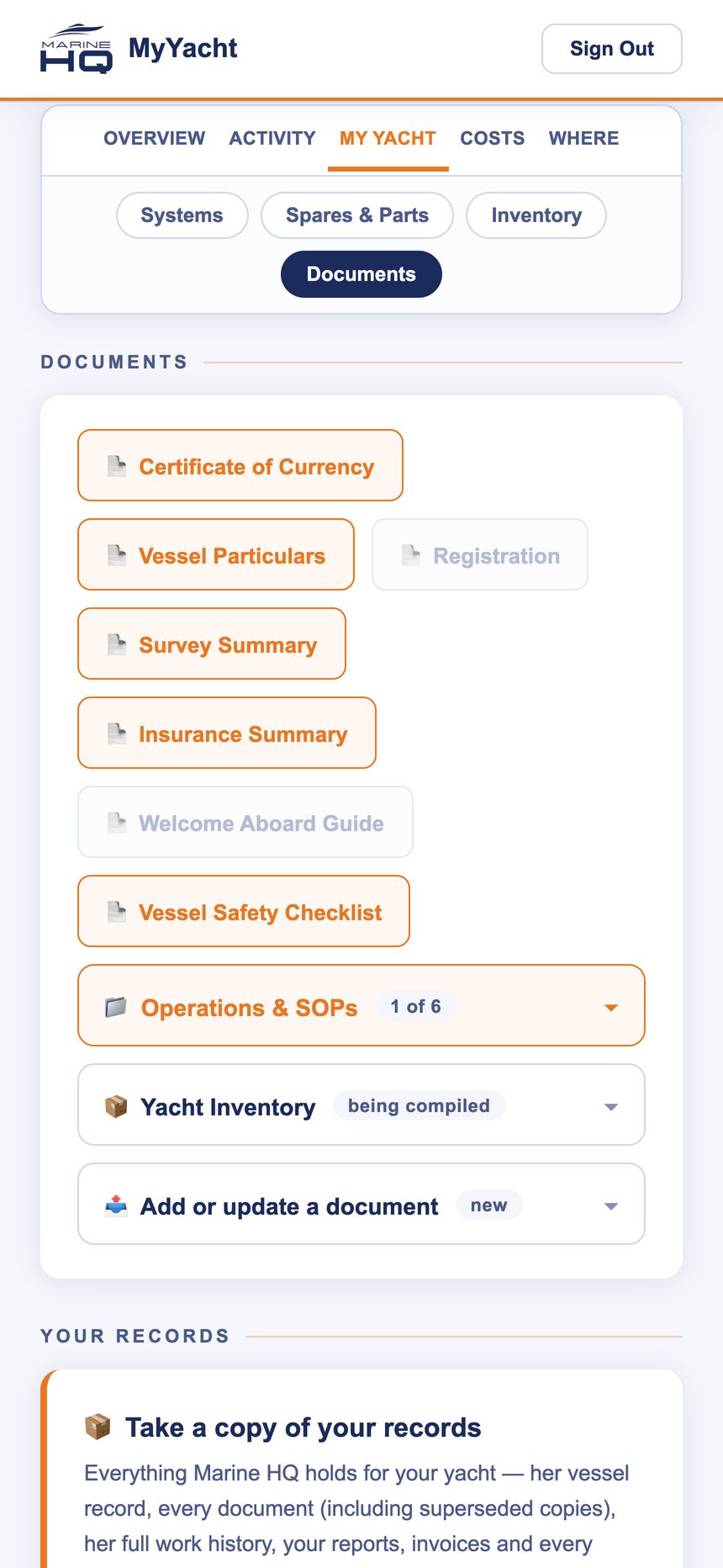
A procedure in a folder is used once. A procedure on the phone in your pocket is used every trip. On a Marine HQ yacht the pre-departure and stand-down checklists live in the MyYacht app: tick as you go, progress is saved on the device, and anything not fitted to your yacht can be skipped. The full written SOPs sit under Documents, with the dossier and the certificates, and open in the app.
What we do
If you run her yourself, start with the three everyday checklists. If you want procedures written for your yacht, or a full Vessel Dossier, call 0439 748 387 or email yachtsupport@marinehq.com.au and tell us what she is and how you use her. We will tell you which procedures she needs and write them aboard.