A 70 to 80 ft luxury motor yacht burns about 50 to 70 litres an hour at 10 to 12 knots, and 330 to 490 litres an hour at 28 knots. At the October 2026 diesel price of $3.24 a litre, that is $162 to $221 an hour slow and $1,056 to $1,575 an hour fast. Speed is the biggest thing you control, and this guide shows what it costs, boat by boat, using published figures for Azimut, Pershing and Sunseeker.
Key facts — October 2026
- Diesel — $3.19 a litre for members, $3.24 for non-members, at the Royal Queensland Yacht Squadron on 1 October
- 71 ft Azimut S7 — about 245 L/h at 24.8 knots, 326 L/h at 28.9 knots
- Pershing GTX80 — about 68 L/h at 10 knots, 439 L/h at 28 knots
- 74 ft Sunseeker 74 Sport Yacht — about 50 L/h at 12 knots, 486 L/h at 28 knots (builder’s figures)
- Per nautical mile — slowing to 10 or 12 knots cuts the fuel cost per mile by more than half on the Pershing and the Sunseeker
The short answer
Fuel is the cost that moves with how much you use the boat. The berth, insurance and registration arrive on the same dates whether she leaves the pen or not. Fuel doesn’t, and the price per litre has moved sharply this spring. If you are budgeting a year, our guide to the cost of owning a yacht on the Gold Coast puts fuel in context with every other line.
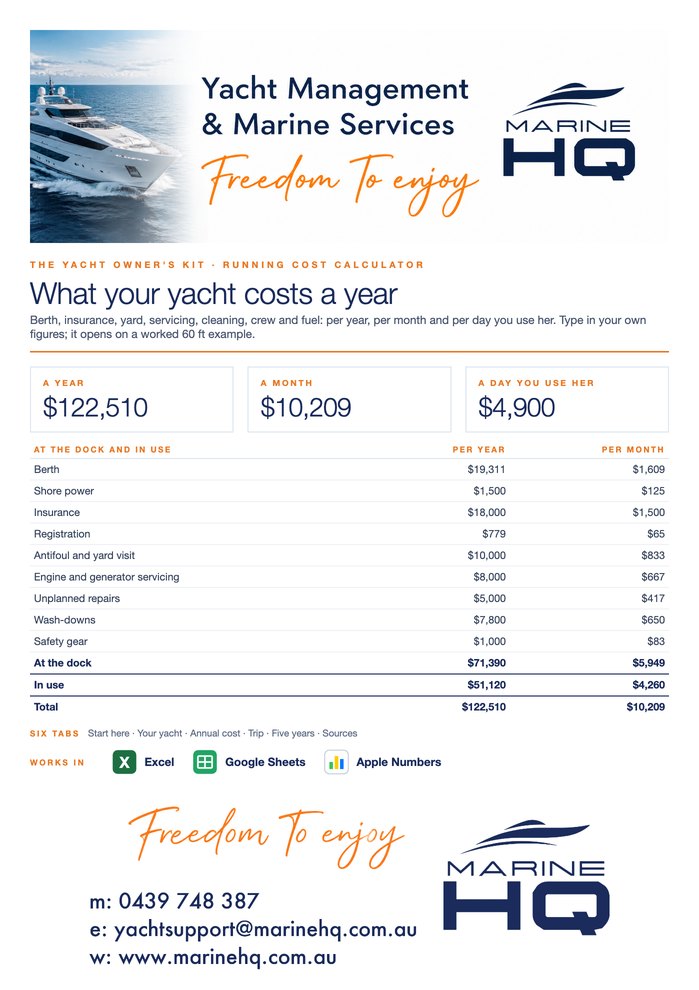 From The Yacht Owner's KitRunning Cost Calculator
What diesel costs today
No Gold Coast marina we found publishes its pump price. The nearest published price is the Royal Queensland Yacht Squadron’s, in Brisbane, updated on 1 October 2026:
| Fuel | Members | Non-members |
|---|---|---|
| Premium diesel | $3.19 a litre | $3.24 a litre |
| Premium unleaded | $3.00 a litre | $3.05 a litre |
A month earlier, on 3 September, the same club listed diesel at $2.79 to $2.84 a litre. That is about 14% more in four weeks. Every dollar figure below uses $3.24 a litre, the non-member price, so it is the cautious end. Ask your own fuel dock for today’s price, and date any number you rely on.
What a luxury motor yacht burns
Two of the boats below were run by Yachting magazine, which reports speed and fuel flow at each engine setting. Its figures are in US gallons an hour, which we have converted at 3.785 litres to the gallon. Both boats have three engines with pod drives.
| Yacht | Engines | Speed | Burn | Cost an hour | Cost a nautical mile |
|---|---|---|---|---|---|
| Azimut S7 (71 ft) | Three Volvo Penta D13 IPS1050, 800 hp each | 24.8 knots | 245 L/h | $794 | $32 |
| 28.9 knots | 326 L/h | $1,056 | $37 | ||
| 36.3 knots (top) | 466 L/h | $1,510 | $42 | ||
| Pershing GTX80 | Three Volvo Penta D13 IPS1350, 1,000 hp each | 10 knots | 68 L/h | $221 | $22 |
| 28 knots | 439 L/h | $1,423 | $51 |
Yachting printed these as three data points in the text, not a full table, and the Azimut test did not state its load. The Pershing’s top speed was 33.6 knots at 2,475 rpm, but the review gives no fuel figure for it. The Azimut was run in calm water off Cannes in the early morning.
Two Sunseekers
Independent sea-trial tables for a Sunseeker of 74 to 76 ft are hard to find. The best published figures are the builder’s own numbers, as listed by YachtBuyer. They are not independent sea trials, and the page does not say what load, weather or sea state they were measured in. We have used them because they are what is published; treat them as a guide to the size of the bill.
| Yacht | Engines | Speed | Burn | Cost an hour | Cost a nautical mile |
|---|---|---|---|---|---|
| Sunseeker 74 Sport Yacht (74 ft) | Twin MAN V12, 1,550 hp | 12 knots | 50 L/h | $162 | $14 |
| 28 knots | 486 L/h | $1,575 | $56 | ||
| 34 knots (top) | 565 L/h | $1,831 | $54 | ||
| Sunseeker 76 Yacht (76 ft) | Twin MAN V12, 1,550 hp | 23 knots | 290 L/h | $940 | $41 |
| 31 knots (top) | 600 L/h | $1,944 | $63 |
The 76 Yacht’s listing gives a 10 knot range of 500 nautical miles but no burn figure at that speed, so there is no slow-speed row for it. Above about 80 ft we found no published burn figure we could trust; ask the builder for the fuel curve for your engines.
Three things stand out.
- Slow is a different cost entirely. The Pershing at 10 knots costs $221 an hour. At 28 knots it costs $1,423, over six times as much, to cover 2.8 times the distance.
- The last few knots cost the most. The Azimut S7 burns 140 more litres an hour going from 28.9 to 36.3 knots, and the Sunseeker 74 costs $256 an hour more at 34 knots than at 28.
- Your boat will not match these. Engines, load, weather, sea state and hull condition all move every number.
Slow versus fast: what 100 hours costs
The same 100 hours underway on each boat, at the lowest and highest speeds published for it.
| Yacht | 100 hours at the lower speed | 100 hours at the higher speed | The difference |
|---|---|---|---|
| Pershing GTX80 (10 and 28 knots) | $22,077 | $142,271 | $120,194 |
| Sunseeker 74 Sport Yacht (12 and 28 knots, builder’s figures) | $16,200 | $157,464 | $141,264 |
| Azimut S7 (24.8 and 28.9 knots) | $79,353 | $105,599 | $26,246 |
| Sunseeker 76 Yacht (23 and 31 knots, builder’s figures) | $93,960 | $194,400 | $100,440 |
A hundred hours at 28 knots is not a hundred hours at the same distance. At 28 knots the Pershing covers about 2,800 nautical miles in 100 hours; at 10 knots it covers 1,000. Fuel is the cost of the hour, which is why the cost per mile in the tables above is the fairer comparison.
Budget trap
Most owners quote a fuel figure from a brochure or a broker. Ask which speed it was measured at. The number at 10 knots and the number at 28 knots can differ by more than a factor of six.
What a full tank is worth
Fuel capacity tells you what a fill costs and how far she can go. From the same two tests:
| Yacht | Tank capacity | Cost to fill from empty at $3.24 |
|---|---|---|
| Azimut S7 | 1,004 US gal (about 3,801 L) | $12,314 |
| Pershing GTX80 | 1,347 US gal (about 5,099 L) | $16,521 |
How to work out your own number
You need three things: the litres an hour at the speed you will run, the hours underway, and the price a litre.
- Litres an hour. Ask the builder or your engineer for the fuel curve for your engines, or look up a published sea trial for your model.
- Hours underway. Count only the engine hours, not the time at the dock.
- Price a litre. Use today’s price from your fuel dock, and add a margin because the price has moved this spring.
For example, a Pershing GTX80 on a two-hour run at 28 knots: 439 litres an hour × 2 hours × $3.24 = $2,845. The same two hours at 10 knots cover about a third of the distance and cost 68 × 2 × $3.24 = $441.
Two things the tables do not include. The generator burns fuel at anchor and overnight, and a speed-and-burn table says nothing about a night at a mooring. And a hull with growth on it burns more at the same speed; our antifouling guide covers how often the Gold Coast’s warm water makes that necessary.
Where fuel money goes
- Speed, not distance. The Pershing’s cost per mile at 28 knots is more than double its cost at 10 knots, and the Sunseeker 74’s is about four times.
- Price timing. Diesel rose about 14% between September and October 2026. A trip priced a month ago is not the trip you pay for now.
- Filling from empty. A full tank is a five-figure cheque on a boat this size. Pay attention to when you fill, not only how much.
- A fouled hull. A hull with growth burns more fuel at the same speed, so part of the antifoul pays for itself.
- Generator and hotel loads. Air conditioning and a generator running at a weekend anchorage add litres the speed tables do not show.
What we do about it
Marine HQ runs the maintenance for motor yachts across the Gold Coast, and fuel is part of how we keep owners informed. For each trip we record the litres taken on at the start and the litres put back at the end, so the owner sees what the trip actually cost, in litres and in dollars, not a guess. It also shows early when a boat starts burning more than she should, which is usually a fouled hull or an engine due for service.
If you are weighing up a purchase or want a straight fuel budget for the boat you already own, call us on 0439 748 387 or email yachtsupport@marinehq.com.au.